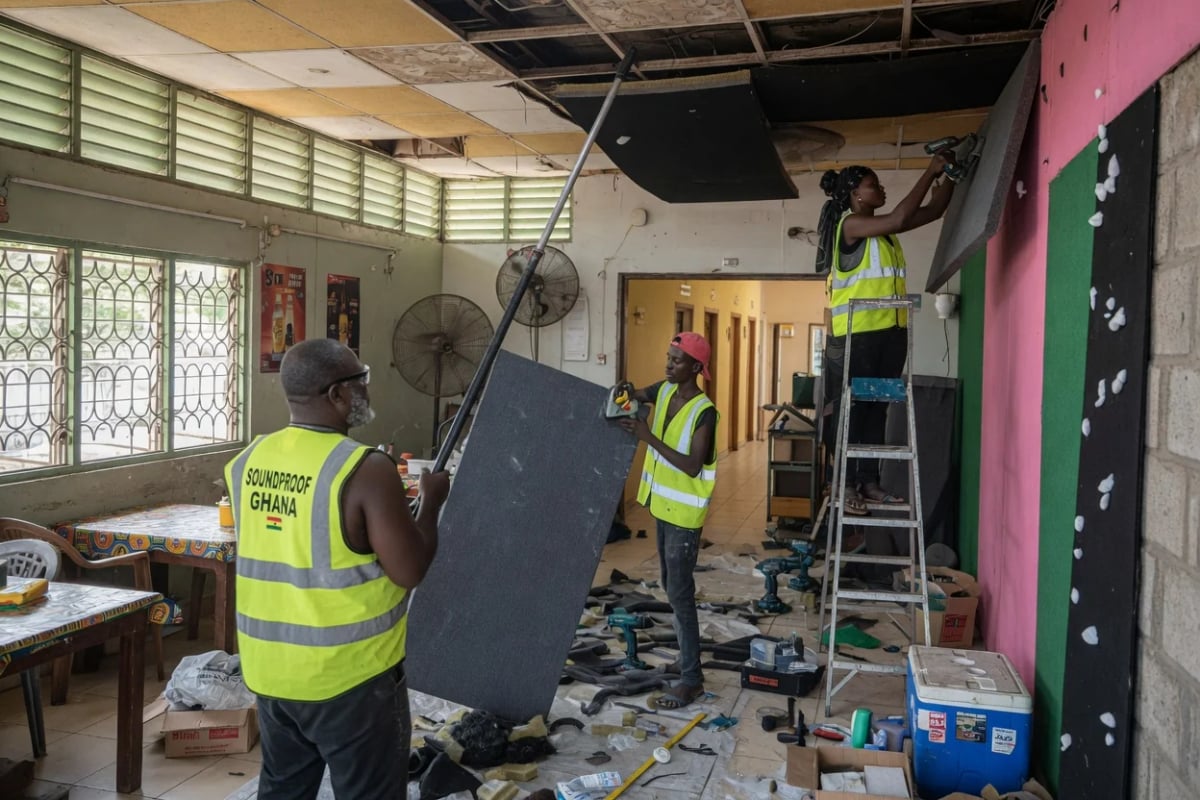
Noise Doesn’t Just Annoy Guests — It Costs You Bookings
A loud room empties tables and a noisy corridor sinks review scores. Surveys of diners suggest the majority avoid restaurants they find too loud — around 72% by some industry findings — and noise even suppresses how good the food tastes, while for hotels noise is consistently among the top guest complaints and feeds directly into online ratings. In a market where bookings follow reviews, acoustic comfort is revenue protection. Soundproof Ghana reduces the din in dining rooms and isolates guest rooms from corridors, plant and each other, to targets we measure and verify. Book a free noise assessment: +233 20 531 3333.
Why Hospitality Operators Specify Soundproof Ghana
Hospitality has two distinct acoustic problems and confusing them wastes money. In restaurants, bars and lobbies the issue is usually reverberation — hard, fashionable surfaces bounce sound until guests raise their voices and the whole room becomes a roar; the fix is absorption, tuned so the space stays lively but conversation is comfortable. In hotels the issue is transmission — a neighbour’s television, a corridor door, footsteps from the room above, or plant noise reaching a bed; the fix is mass, sealing and impact isolation. Foam solves neither reliably. We diagnose which problem each space has and design to a measured target.
As a survey-and-install contractor we can phase work around a live operation, treating a dining room or a floor of rooms with minimal disruption, and we coordinate with interiors so acoustic solutions read as part of the design rather than an afterthought.
The Particular Requirements of Ghanaian Hospitality
Ghanaian hotels and restaurants are typically concrete-built with hard finishes, and often sit near busy roads, generators and nightlife — so both internal reverberation and external intrusion are in play. Guest-room isolation depends on party walls, the floor/ceiling assembly and, critically, the door and its seals, since a one-percent gap around a door can cost the better part of ten decibels. GS 1222:2018 sets a commercial ambient guideline of 75 dB(A) day / 65 dB(A) night, a useful reference for what a venue may emit, while guest comfort is designed to a much quieter interior target.
Climate governs the specification. In humid coastal Accra and Tema we use mould- and moisture-resistant mineral-wool and PET/polyester treatments and termite-treated or marine-grade timber, avoiding open-cell foam that degrades in sustained humidity — important where kitchens and bathrooms add moisture load. The result is durable comfort, not a finish that fails within a couple of seasons.
Recommended Services for Hospitality, Hotels & Restaurants
- Acoustic treatment & echo control — absorption to cut reverberation in dining rooms, bars and lobbies so guests linger and spend
- Wall soundproofing — sealed, high-STC party walls between guest rooms and against corridors
- Ceiling & floor impact soundproofing — impact isolation so footfall and furniture noise do not carry between floors
- Commercial & venue acoustic fit-out — turnkey acoustics for ballrooms, function suites and event spaces
Typical Hospitality Engagements
The most common restaurant brief is the room that is simply too loud: absorption to bring reverberation down to a comfortable, conversational level — measured before and after — so guests stay longer, order more and leave better reviews. Bars and function suites add bass containment so events do not disturb rooms or neighbours.
For hotels, the recurring engagement is guest-room isolation: party walls, floor/ceiling assemblies and door sets upgraded to a target that lets guests sleep despite corridors, neighbours and plant. A third pattern is the ballroom or event suite that must host live sound without bleeding into the rest of the property. Throughout, we commit to a measured, verifiable target rather than promising a totally silent room that a working venue cannot deliver.