The problem
The constant hum of your AC, HVAC plant, or mechanical equipment never lets a room feel quiet.
Our approach
HVAC & Mechanical Hum Control
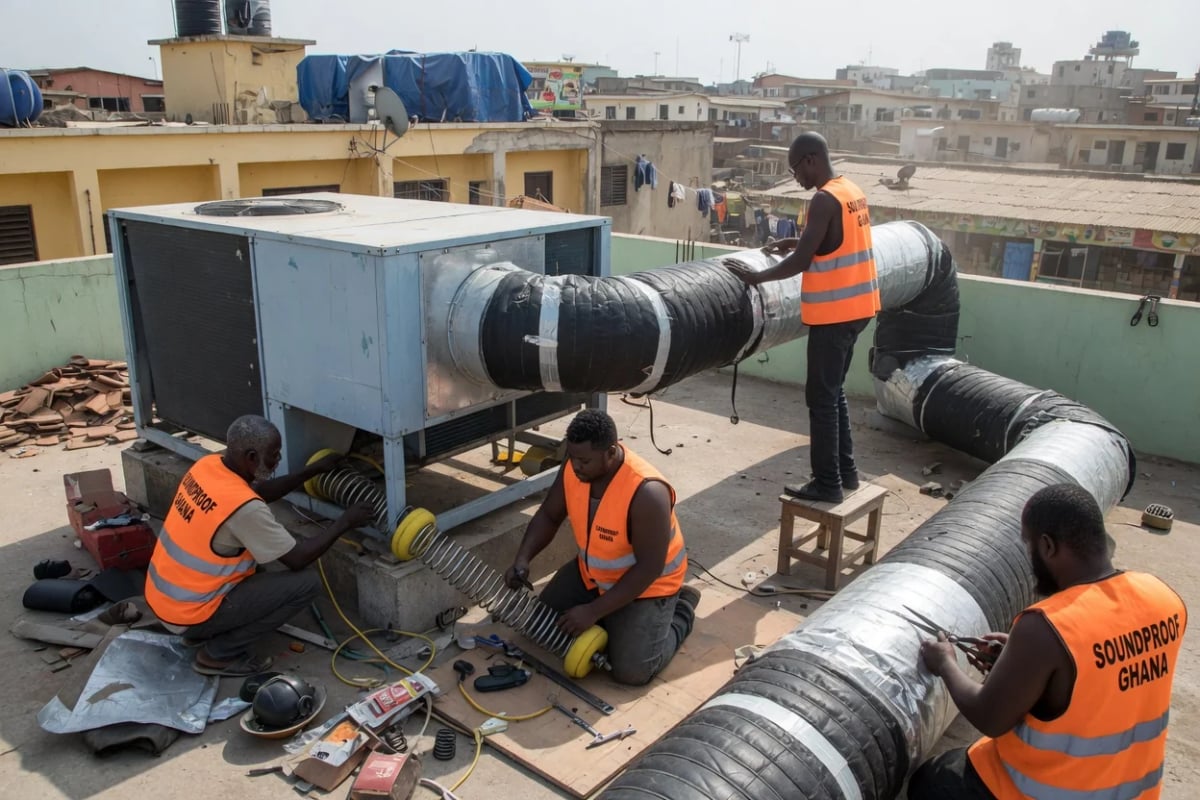
AC, HVAC, and plant hum controlled with duct silencers, vibration isolation, and pipe and duct lagging — the equipment stays effective while the noise floor drops to a measured target.
Our process
-
Assess
A free assessment identifies whether the hum reaches you through the air, along the ducts, or as vibration through the structure — usually a mix of all three.
-
Measure
We measure the noise floor in the affected room and at the plant, and pick out the low-frequency hum that makes a space feel restless even at modest levels.
-
Design
We specify duct silencers, anti-vibration mounts, flexible connectors, and pipe or duct lagging — chosen so airflow and cooling capacity are preserved.
-
Install
We fit the silencers, isolators, and lagging with materials that tolerate heat and humidity, and treat any wall or ceiling the plant noise radiates through.
-
Verify
We re-measure the noise floor and document the reduction against the target, confirming the equipment still performs as intended.
The Challenge
Air-conditioning and mechanical plant are essential in Ghana’s climate — but the hum they produce is one of the most wearing noises to live and work with, precisely because it never stops. A split-unit compressor mounted on a bedroom wall, a ducted system whose grilles roar on start-up, a plant room whose fans drone through the floor of the office above: these are low-frequency, continuous sounds that the ear stops “hearing” consciously but the body never fully relaxes around. Even at a modest decibel level, a persistent hum makes a room feel restless.
Mechanical hum reaches you by more than one route, which is why treating a single symptom rarely works. There is airborne noise radiating off the unit and out of the grilles; duct-borne noise carried along the ductwork and delivered straight into the room through the diffuser; and structure-borne vibration passing from the equipment feet into the slab, wall, or ceiling and re-radiating as hum in rooms that may be some distance away. Chasing the compressor while ignoring the ducts, or lagging a pipe while the unit still shakes the wall it hangs on, leaves most of the problem in place.
The constraint that makes this specialised work is that the equipment has to keep doing its job. You cannot simply seal a plant room or choke a duct — the cooling, the airflow, and the equipment’s own reliability all depend on it breathing. The engineering is in quietening the machine without degrading it.
The Soundproof Ghana Solution
We start by separating the paths, because each needs a different fix. For duct-borne noise, we fit acoustic duct silencers (attenuators) and, where needed, plenum treatment and lagging along the run, so the sound is absorbed before it reaches the diffuser rather than delivered with the air. For structure-borne vibration, we mount the unit or plant on anti-vibration isolators or spring hangers and install flexible connectors, so the hum is broken at the source before it ever enters the wall, slab, or ceiling. For airborne noise off the plant itself, we add absorptive treatment or a mass-and-lining enclosure to the plant room, and treat the wall or ceiling into any occupied space beyond.
Throughout, we choose materials that survive Ghana’s conditions — mineral-wool and moisture-resistant linings rather than bare foam, which absorbs humidity and degrades where relative humidity stays high. Critically, every measure is sized to preserve airflow and cooling capacity: silencers are selected for low pressure drop, and ventilation is designed in wherever sealing might otherwise reduce it. A quiet system that no longer cools is not a solution, and we design against that from the outset.
We commit to a measured reduction of the noise floor to an agreed target, verified before and after, not a promise of silence from equipment that must keep running.
Service Framework
- Free assessment separating airborne, duct-borne, and structure-borne hum paths
- Noise-floor measurement in the affected room and at the plant, with low-frequency analysis
- Acoustic duct silencers and attenuators sized for low pressure drop and preserved airflow
- Anti-vibration mounts, spring hangers, and flexible connectors to break structure-borne hum
- Pipe and duct lagging and plant-room lining to absorb airborne plant noise
- Wall and ceiling treatment on the path into occupied rooms beyond the plant
- Materials chosen for heat and humidity, with before-and-after noise-floor verification
Typical Engagement
An HVAC-noise engagement ranges from a single bedroom disturbed by a wall-mounted compressor to a commercial building where a plant room or ducted system is raising the noise floor across offices, a clinic, a hotel, or a conference space. Domestic work often centres on isolating a condenser and treating the wall it hangs on; commercial work usually involves duct silencers and plant-room isolation coordinated with the mechanical installer so cooling performance is protected. Where the plant is shared or the disturbance affects multiple rooms, we scope the full distribution path rather than the nearest grille alone.
Outcomes
- Continuous AC and plant hum reduced to a measured noise-floor target you can rest and concentrate in
- The right path treated — duct, vibration, or airborne — so the hum is removed at source, not chased
- Airflow and cooling capacity preserved by design, so the equipment still performs
- Low-frequency drone addressed specifically, since that is what makes a room feel restless
- A documented before-and-after noise-floor result in the affected space
Book a free noise assessment: +233 20 531 3333.