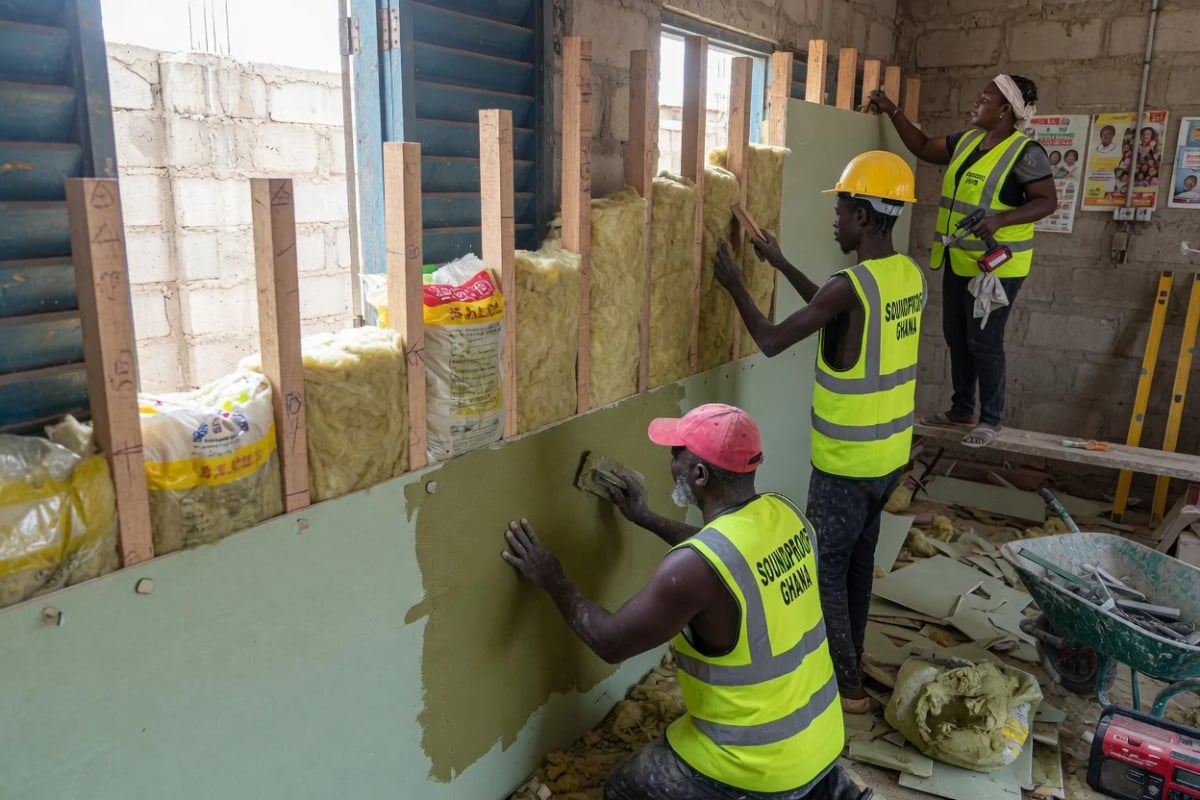
Wall Soundproofing
Engineered wall systems that block airborne noise between rooms and neighbours — added mass, structural decoupling and airtight sealing, designed to a measured STC target and verified before and after.
Neighbour’s TV through the bedroom wall? Voices carrying between offices? Wall soundproofing blocks airborne noise passing between rooms — but only if it is engineered, not guessed. Soundproof Ghana surveys the actual noise path, designs the wall to a measured STC target, and verifies the reduction in decibels before and after. Book a free noise assessment: +233 20 531 3333.
What Wall Soundproofing Actually Is
Wall soundproofing is the practice of raising a wall’s ability to block airborne sound — voices, television, music, traffic, generator hum — as it passes from one room or property to another. It is measured by Sound Transmission Class (STC): around 30, normal speech is clearly audible through the wall; around 50 is the threshold most codes treat as adequately private between dwellings; around 60, speech is effectively inaudible. Think of STC like an SPF rating for noise — a higher number means far less gets through, not a guarantee of nothing at all.
This is a completely different job from acoustic treatment. Foam and fabric panels stuck to a wall absorb echo inside a room; they add almost no blocking between rooms. A sponge on the wall never sealed the lid. If your problem is a neighbour you can hear, you need mass, decoupling and sealing — not decoration.
When to Specify Wall Soundproofing
Specify wall soundproofing when sound is crossing a wall and disturbing sleep, focus, privacy or a business operation. Typical Accra, Tema and Kumasi cases include party walls between apartments in the many concrete, thin-partition developments across the city; bedroom walls facing a noisy neighbour, a roadside spot or a compound generator; office and boardroom walls where confidential conversation must not carry to the corridor; clinic consulting rooms where the waiting room can currently hear the consultation; and home cinemas or studios that must not leak into the rest of the house.
It is also the right service before you build. The cheapest time to reach a noise target is at design stage, in the stud layout, not after the plaster is up and the complaints have started. Where you are letting or selling, a genuinely quiet party wall is a premium buyers pay for — market analyses suggest noise materially affects property value, so the wall is an investment, not just a comfort.
The Method — Which Pillars We Use
Effective wall blocking relies on three of the four acoustic pillars — Mass, Damping and Decoupling — working together. Any one alone underperforms; combined, they multiply.
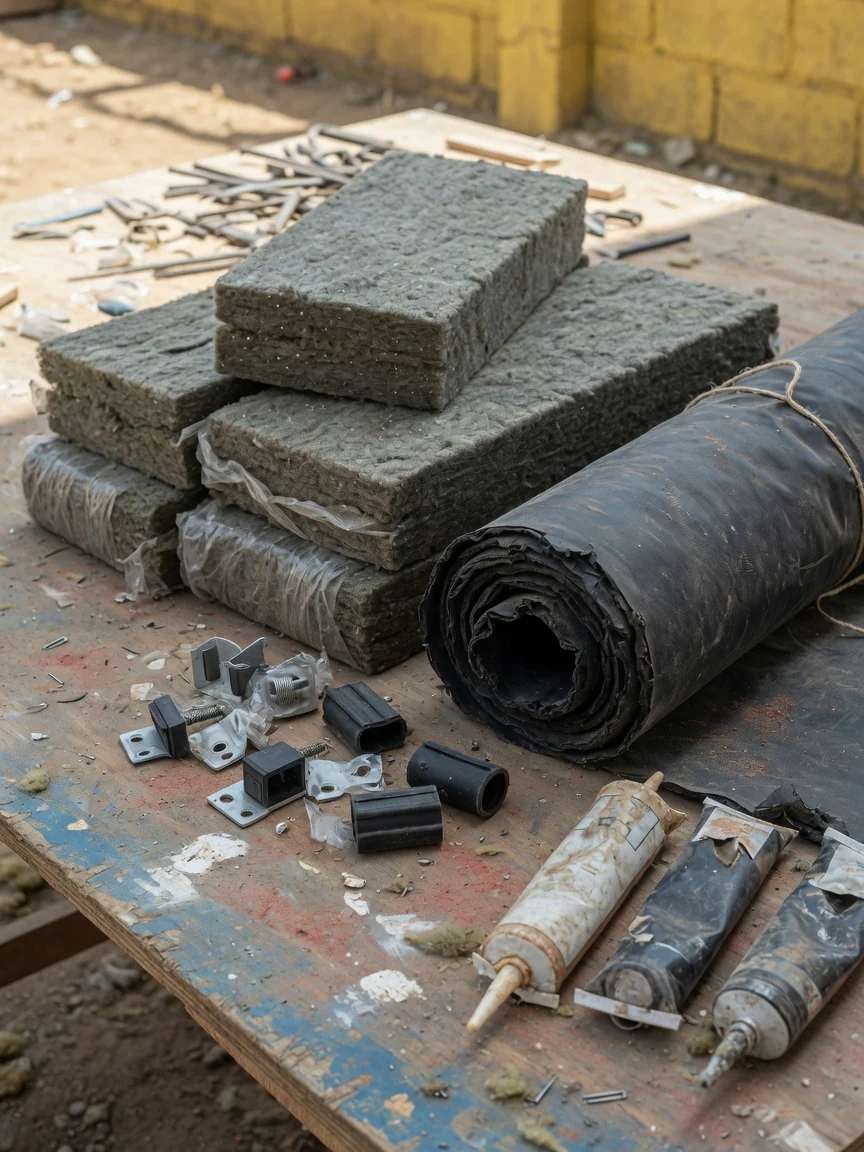
- Mass — heavier, denser layers resist being vibrated by sound. We add damped board build-ups so the wall has enough mass to matter. But mass has diminishing returns (the mass law), which is why we never rely on it alone.
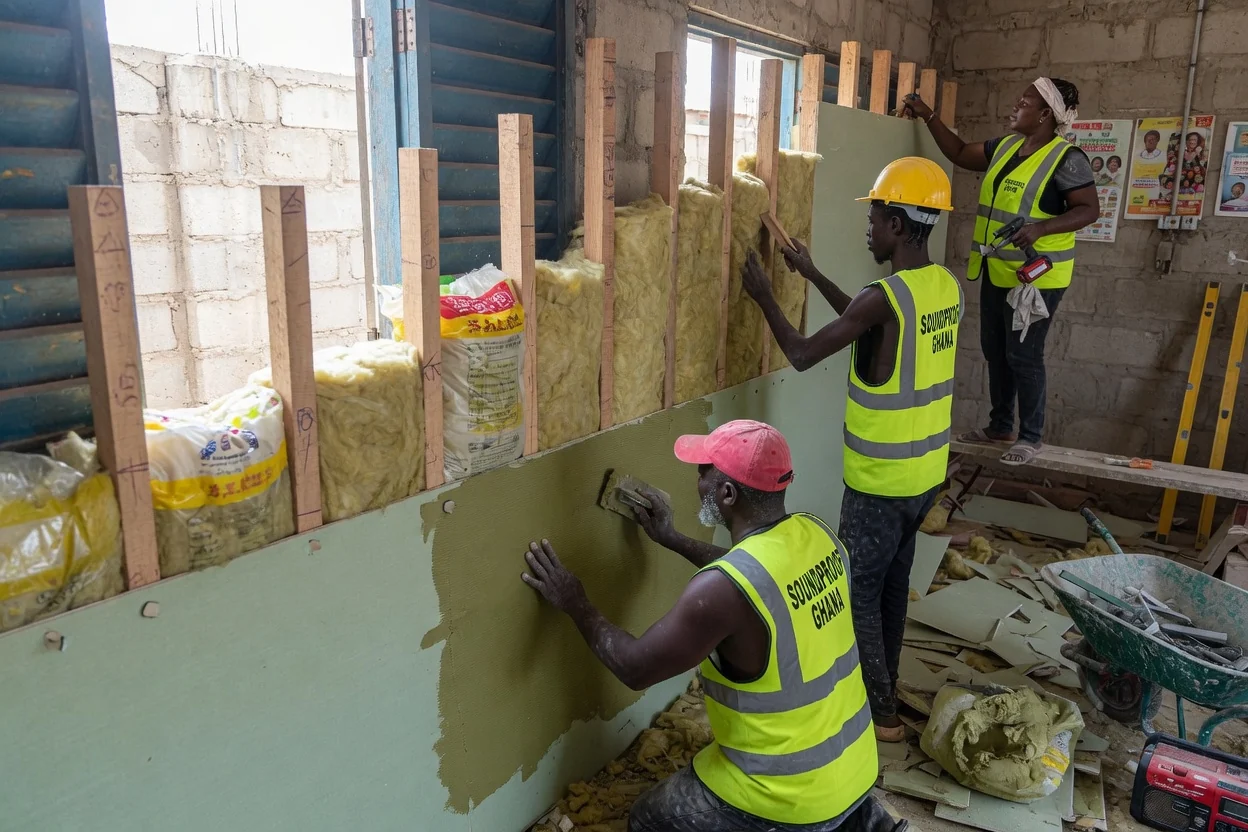
- Decoupling — this is where the real gains live. By separating the two faces of the wall so they are not rigidly connected — using isolation clips, resilient (hat) channel, staggered studs or fully independent studs with an air gap — we break the direct path vibration would otherwise take straight across. Two masses separated by a spring block far more than the same material stuck solid. It is like cutting a taut string in the middle: the far end stays still.
- Damping — a viscoelastic layer between rigid boards turns vibration into a tiny amount of heat, killing the resonance that lets low frequencies punch through. It is the equivalent of pressing a finger to a ringing wine glass, built permanently into the wall.
- Sealing (the multiplier) — the cavity is filled with mineral wool, and every edge, socket, service penetration and junction is sealed airtight. We also treat the flanking paths the survey found — shared ceiling voids, back-to-back sockets, door undercuts — because sound takes every route, and a waterproof wall means nothing if the door is left open.
We specify mineral (stone) wool for the cavity deliberately. In Ghana’s humid coastal climate, where relative humidity routinely sits above 60 to 70%, mineral wool is water-repellent and mould-resistant and holds its performance, while bare open-cell foam absorbs moisture and degrades. The materials are chosen for the climate, not just the acoustics.

Typical Result Ranges
A bare single-leaf partition or a basic block wall commonly sits in the low STC range where speech carries clearly. A properly designed decoupled and damped wall system moves a partition well up toward, and past, the STC 50 privacy threshold — enough that normal conversation and television next door drop to a faint, non-intrusive murmur, and in higher builds become effectively inaudible. Low-frequency bass from a club, a sound system or a large generator is always the hardest to stop, and demands the most mass, decoupling and depth; we set an honest target for it up front rather than overpromise.
Every project is quoted against a number established at the survey, and we hand you before-and-after readings on completion. You are never asked to take the result on faith.
Honest Boundaries
We will never promise “100% soundproof” or “total silence” — no wall delivers that, and anyone claiming it is selling a fantasy. We reduce the transmitted level to a measured target and verify it. The achievable target depends on the existing structure, the flanking paths available to sound, how much depth you can give up and the frequency of the noise (bass is hardest). Where a target you want is not realistic within the constraints of the room, we tell you before you spend, not after. And sealing is not negotiable — if the flanking paths are not treated, even a perfect wall underperforms.
Related Services
Wall soundproofing is often paired with the other blocking and treatment disciplines to close every path noise can take:
- Ceiling & Floor Impact Soundproofing — footfall and impact noise from above
- Soundproof Doors & Seals — the door is usually the weakest link in a treated wall
- Acoustic Windows & Secondary Glazing — for road, traffic and generator noise entering through glass
- Acoustic Treatment & Echo Control — for echo and reverberation inside the room, a different problem from blocking