The problem
You upgraded a wall or door, yet the noise still gets through — because it is sneaking around the barrier.
Our approach
Flanking Noise Control
Sound sneaking around a barrier traced and sealed at every route — gaps, junctions, shared floors and ceilings, ducts, and back-to-back sockets — so the wall you paid for actually performs.
Our process
-
Assess
A free assessment maps every route the sound is taking around the barrier — the junctions, ceiling void, ducts, sockets, door undercut, and shared floor.
-
Measure
We assess how much noise is bypassing the main barrier versus passing through it, so effort goes to the paths that actually matter.
-
Design
We specify sealing and treatment for each flanking route — perimeter junctions, penetrations, socket boxes, duct paths, and door and skirting gaps.
-
Install
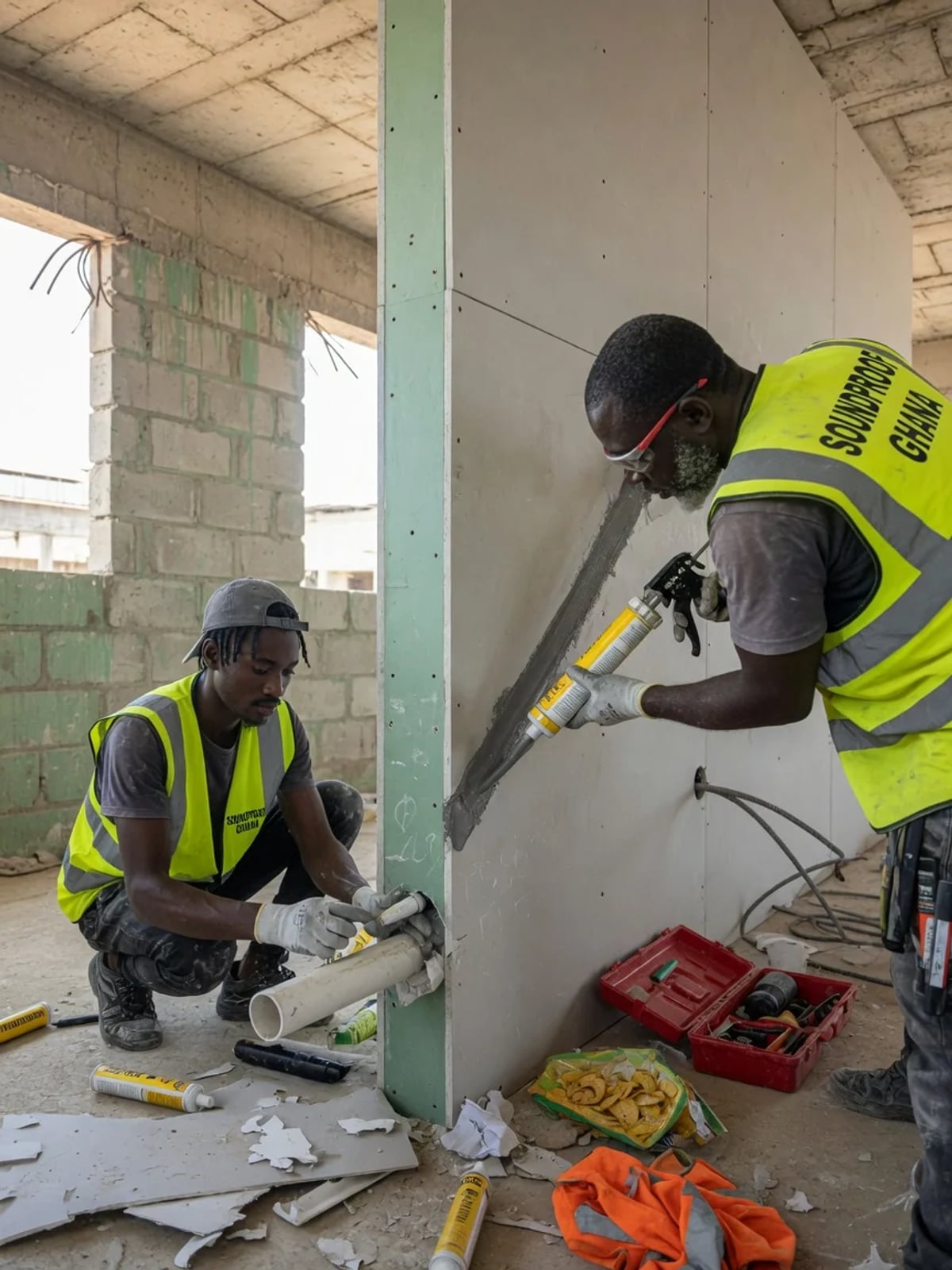
We seal and treat every identified path with durable, humidity-appropriate materials, closing the routes that were undermining the barrier.
-
Verify
We reassess and confirm the barrier now performs closer to its potential, with the flanking routes closed.
The Challenge
One of the most disheartening experiences in soundproofing is spending money on a good wall, a solid door, or a treated ceiling — and still hearing the noise. When that happens, the barrier itself is usually not the problem. The sound is taking a different route: around, over, under, or through the many small paths that bypass the main surface entirely. This is flanking noise, and it is the reason so many well-intentioned soundproofing attempts disappoint.
Sound behaves like water: it takes every available route, and it only takes one open path to undermine an otherwise excellent barrier. A waterproof wall means nothing if the door is left open — and acoustically, a great wall means little if sound simply travels over it through the ceiling void, under it through the door undercut, alongside it through back-to-back electrical sockets, or straight past it through a shared duct. Even a one-percent gap around a barrier can cost a large share of its performance, because sealing matters as much as the material itself.
Flanking paths are especially common in Ghanaian construction, where partitions frequently stop at a suspended ceiling rather than the slab above, ducts and conduits run between rooms, and junctions between walls, floors, and ceilings are rarely sealed for sound. The result is that the most expensive element in the room — the upgraded wall — is quietly let down by the cheap, unsealed paths around it. Flanking is not an exotic problem; it is the usual reason a soundproofing job under-delivers.
The Soundproof Ghana Solution
Flanking is a detective problem before it is a construction problem, and that is how we approach it. We map every route the sound is taking around the barrier: the junctions where wall meets floor and ceiling, the ceiling void above a partition that stops short of the slab, the door undercut and unsealed frame, back-to-back or shared socket boxes, skirting and service penetrations, and any duct or pipe that runs from one room to the other. Then we assess how much noise is bypassing the main barrier versus passing through it, so the effort goes where it will actually change what you hear.
From there we seal and treat each path deliberately. Perimeter junctions are sealed; a partition that stops at the ceiling is closed over the top or the void is treated; door undercuts are sealed with drop seals and perimeter kits; socket boxes are backed and sealed rather than left back-to-back; and duct paths are silenced or lagged so they no longer carry sound between rooms. We use durable, humidity-appropriate materials — mineral-wool and moisture-resistant sealants rather than bare foam — so the sealing holds up in Ghana’s climate.
We are honest about what this achieves: closing flanking paths lets a barrier perform closer to its real potential, and often turns a disappointing wall into an effective one. We commit to a measured improvement, verified before and after, rather than a promise of silence.
Service Framework
- Free flanking survey mapping every route around the barrier — junctions, void, door, sockets, ducts
- Assessment of how much noise bypasses versus passes through the main barrier
- Perimeter and junction sealing where wall meets floor, ceiling, and adjoining walls
- Closure or treatment of ceiling voids above partitions that stop short of the slab
- Door drop seals, perimeter kits, and skirting and penetration sealing
- Socket-box backing and duct silencing or lagging to close service-borne paths
- Durable, humidity-appropriate materials, with before-and-after verification
Typical Engagement
A flanking engagement often follows a previous soundproofing attempt — by us or others — that has under-delivered, as well as new work where we design out flanking from the start. It ranges from a single wall in a home whose neighbour noise persists despite an upgrade, to a commercial fit-out where partitions, ceilings, and ducts create a network of bypass paths across a floor. Because much of the work is sealing and detailing rather than heavy construction, it is frequently quick and low-disruption, and it is often the most cost-effective way to unlock the performance of a barrier already in place.
Outcomes
- The wall, door, or ceiling you already paid for finally performing closer to its potential
- Every bypass route — over, under, around, and through — found and closed, not just the obvious surface
- Effort concentrated on the paths that measurably change what you hear
- Durable, humidity-appropriate sealing that holds up in Ghana’s climate
- A measured before-and-after improvement, with flanking routes documented and closed
Book a free noise assessment: +233 20 531 3333.