The problem
You hear every footstep, dragged chair, and thud from the floor above.
Our approach
Impact & Footfall Noise Control
Footsteps and impact from above controlled with floating floors, resilient underlayment, and ceiling isolation — the structure-borne path broken, not just softened, and verified.
Our process
-
Assess
A free assessment confirms the noise is impact rather than airborne, and whether the best route is treating the floor above, the ceiling below, or both.
-
Measure
We assess the existing floor and ceiling build-up and set a realistic impact-reduction target for the rooms and how they are used.
-
Design
We design a floating floor or resilient underlayment above, an isolated ceiling below, or a combined system — sized to break the structure-borne path.
-
Install
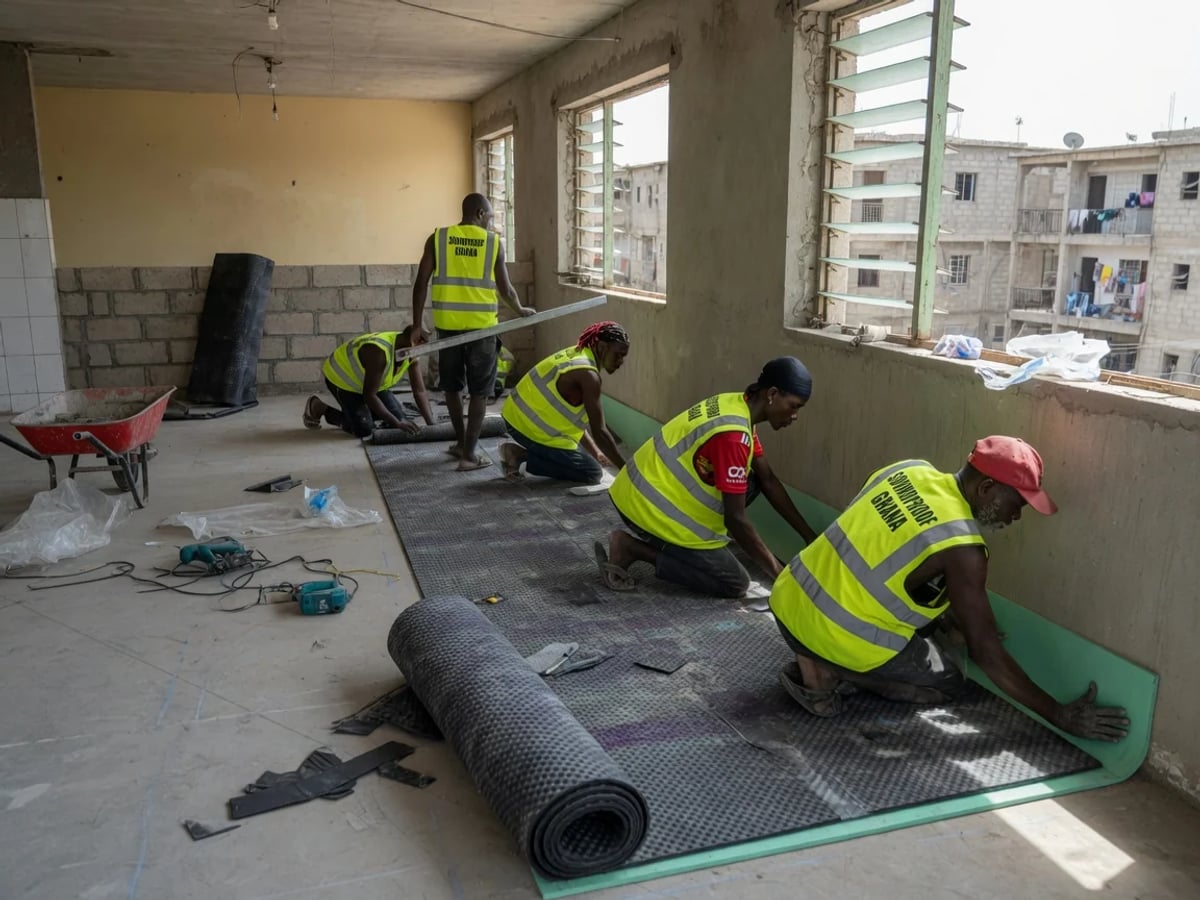
We install resilient layers, isolation clips or hangers, and decoupled build-ups with sealed perimeters, using durable materials suited to Ghana's climate.
-
Verify
We assess the result after installation and document the reduction in impact noise against the agreed target.
The Challenge
Living below an active floor — in an apartment, a duplex, or a multi-storey home or office — means living with a particular kind of noise that ordinary walls and panels do nothing for: footsteps, dragged chairs, dropped objects, children running, heels on tile. This is impact noise, and it is fundamentally different from the airborne noise of voices or music. Airborne sound travels through the air first; impact noise is something physically striking the structure and travelling through the building as vibration, radiating out of the ceiling below as a thud you feel as much as hear.
Because it is structure-borne, impact noise cannot be fixed the way you fix a noisy conversation through a wall. Adding mass to a ceiling helps only a little, because the vibration is already inside the concrete or timber and travelling through it. The knocking is on the structure itself, and the answer is not to make the barrier heavier but to break the path — to separate the surface that gets struck from the structure that carries the sound, or to hang the ceiling below on isolators so the vibration cannot pass straight into it.
In much of Ghana’s multi-storey construction — concrete slabs finished with hard tile — impact noise is especially pronounced, because a hard surface on a rigid slab transmits every footfall efficiently into the rooms below. It is one of the most common and most misunderstood complaints in apartments and family homes, and one of the few that a floating-floor or isolated-ceiling system is specifically built to solve.
The Soundproof Ghana Solution
We treat impact noise as a decoupling problem, and there are two places to break the path: the floor above and the ceiling below. Wherever possible, the most effective route is to treat the floor above — a floating floor or a resilient underlayment installed under the finished surface, so the layer that gets struck is separated from the structural slab by a resilient layer. The footstep energy is absorbed and isolated before it ever reaches the concrete, which is far more effective than trying to stop it after it has spread through the structure.
Where the floor above cannot be lifted — a tenant situation, an occupied space, a finished tile floor you do not want to remove — we treat the ceiling below instead: an independent or resilient-mounted ceiling hung on isolation clips or hangers, with a mineral-wool cavity and a damped board build-up, decoupled from the slab so the vibration cannot pass straight into it. In the most demanding cases we combine both. Throughout, perimeters are sealed and edges isolated, because a floating floor that touches the wall at its edge “short-circuits” and leaks the very vibration it was meant to contain.
We choose resilient layers and materials that hold their performance in Ghana’s humidity and carry the loads of real use. We commit to a measured reduction in impact noise to an agreed target, verified after installation — not a promise that the floor above will become perfectly silent.
Service Framework
- Free assessment confirming impact (not airborne) noise and the best route to treat it
- Evaluation of the existing floor and ceiling build-up and a realistic impact-reduction target
- Floating floors and resilient underlayment above to isolate the struck surface from the slab
- Independent or resilient-mounted isolated ceilings below on clips or hangers where the floor cannot be lifted
- Mineral-wool cavities and damped board build-ups within the isolated system
- Sealed, isolated perimeters so the floating layer does not short-circuit to the structure
- Durable, load-appropriate, humidity-tolerant materials with after-installation verification
Typical Engagement
An impact-noise engagement typically covers a room or a whole floor in an apartment, duplex, or multi-storey home or office in Accra, Tema, or Kumasi — a bedroom under a living area, a home office under a family room, or a quiet commercial suite under an active one. Where we can lift or overlay the floor above, that is usually the route; where we cannot, an isolated ceiling below delivers the result. Work can often be phased and, for ceiling treatments, carried out from below without disturbing the upstairs occupant.
Outcomes
- Footsteps, dragged furniture, and impact thuds from above reduced to a measured target
- The structure-borne path broken, not merely softened, so the fix actually addresses impact noise
- The right route chosen — floor above or ceiling below — for your building and occupancy
- Perimeters isolated so the system performs as designed rather than short-circuiting
- A documented reduction in impact noise, verified after installation
Book a free noise assessment: +233 20 531 3333.