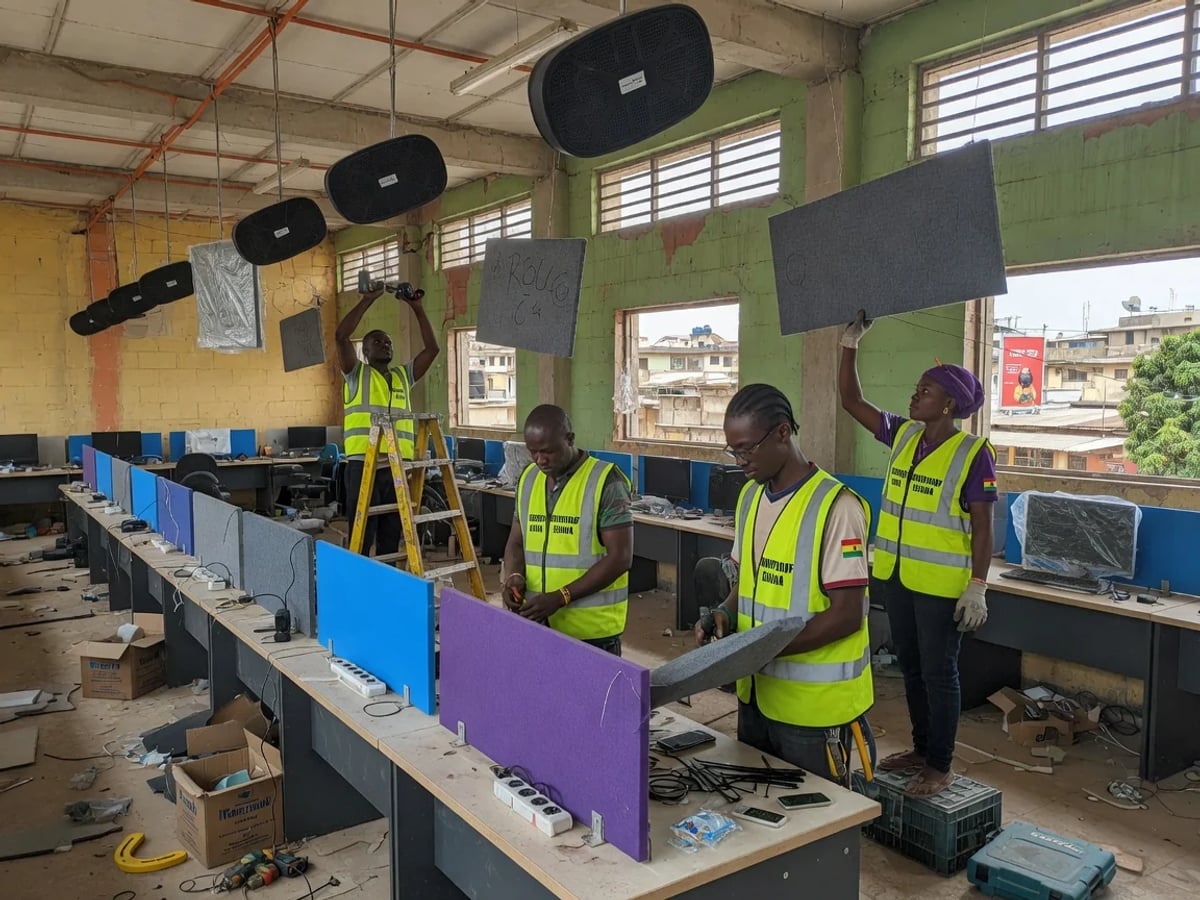
Every Agent Talking Is Noise for Every Agent Beside Them
A call centre is the hardest acoustic problem in commercial work: dozens or hundreds of people all speaking at once, on a hard-surfaced floor, each voice becoming background noise for everyone else. The result is a rising noise floor, agents raising their voices, callers struggling to hear, and confidential conversations carrying across the room. Intelligible speech — not sheer volume — is what breaks concentration, and it takes an interruption to derail focus. Soundproof Ghana lowers the floor with absorption and lifts privacy with masking, so calls are clear and conversations stay contained, to targets we measure and verify. Book a free noise assessment: +233 20 531 3333.
Why BPO Operators Specify Soundproof Ghana
Scale changes the physics. On a large agent floor, absorption is essential to stop each voice reflecting off ceilings and walls and adding to the general din, while electronic sound masking raises a controlled, even background sound that renders neighbouring conversations unintelligible — the two working together are what keep a busy floor both quiet enough to work in and private enough to be compliant. Foam tiles alone cannot deliver this at scale, and a BPO needs a designed, whole-floor scheme. As a survey-and-install contractor we measure the noise floor and speech-privacy conditions and engineer to a target across the entire space.
Speech privacy also carries a data dimension. BPO and call-centre work frequently handles personal and financial information, engaging Ghana’s Data Protection Act, 2012 (Act 843) and client confidentiality commitments; overheard conversations are a genuine compliance and reputational risk, not just a comfort issue. We design masking and absorption to make residual speech unintelligible off-position.
The Particular Requirements of Ghanaian Call Centres
Ghana is a growing BPO destination, and its call centres are typically large open floors in concrete buildings with hard surfaces and dense seating — acoustically the worst-case combination. A standby generator and heavy HVAC add to the background load, and open plans mean supervisor, QA and training areas often share air with the main floor. GS 1222:2018 sets an office ambient guideline of 55 dB(A) day / 50 dB(A) night, a useful design anchor for a workable noise floor.
Climate and durability shape the specification. In humid coastal Accra and Tema we use mould-resistant mineral-wool and PET/polyester ceiling and wall systems that hold performance in high humidity and take the wear of a 24-hour operation, rather than open-cell foam that degrades. Ceiling treatment is usually the highest-leverage surface on a call-centre floor, and we prioritise it accordingly.
Recommended Services for Call Centres & BPO
- Acoustic treatment & echo control — ceiling and wall absorption to lower the noise floor across large agent areas
- Sound masking & speech privacy — a tuned masking system so neighbouring calls and confidential data are no longer intelligible off-position
- Wall soundproofing — sealed partitions for training rooms, QA booths and supervisor offices that need to stay quiet
- Commercial & venue acoustic fit-out — turnkey acoustic design coordinated with your floor layout and interiors
Typical BPO Engagements
The most common brief is the open agent floor whose noise floor is too high: agents strain to hear callers and conversations carry. Here whole-floor ceiling and wall absorption combined with a masking system brings the floor down to a workable, private target, measured before and after.
A second pattern is the confidentiality-critical operation — financial, health or client-sensitive work — where speech privacy is engineered to a demonstrable standard for compliance. A third is the training, QA or supervisor space that must stay quiet against the main floor, solved with sealed partitions and local treatment. In every engagement we commit to a measured, verified target rather than an unrealistic promise of a totally silent floor.