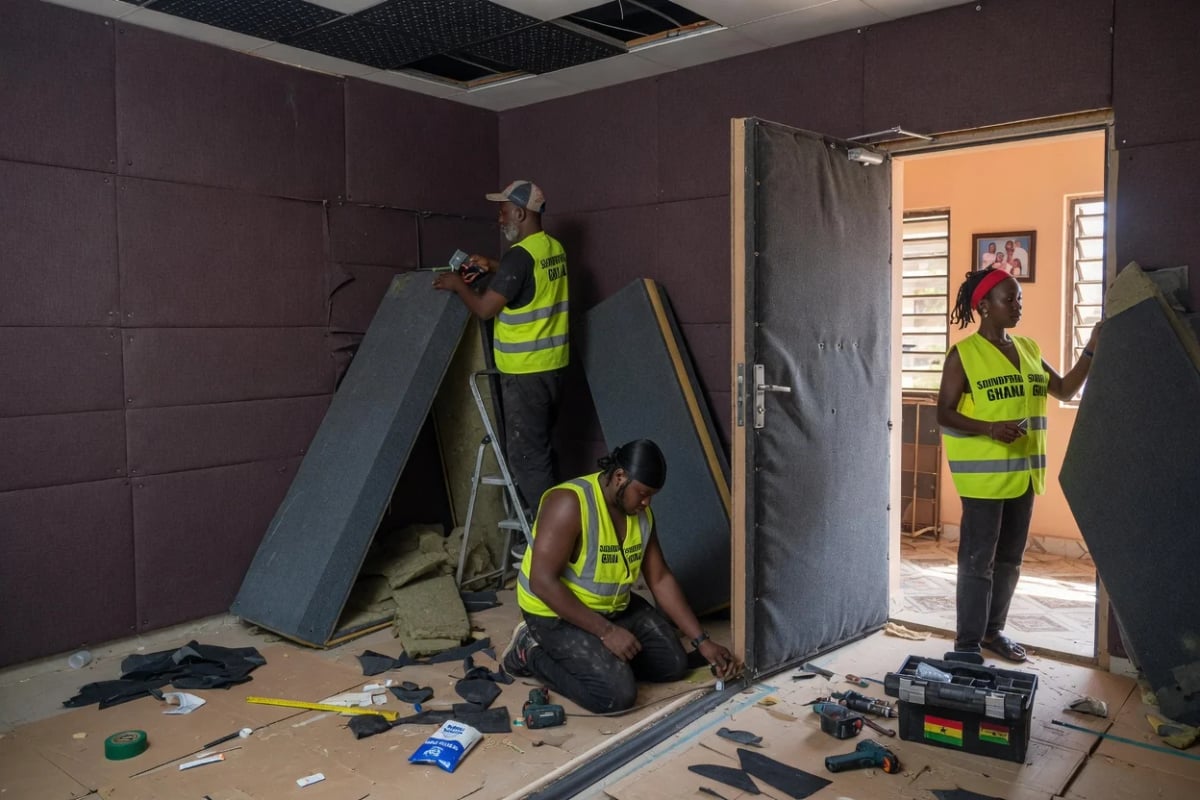
Full Cinema Impact Inside — Silence for the Rest of the House
A home cinema has to solve two opposite problems at once: keep the sound in, so the film’s full impact does not travel to bedrooms and neighbours, and make the room itself sound right, so dialogue is clear and effects are precise. These are different jobs — blocking versus treatment — and confusing them is why so many media rooms either leak into the whole house or sound muddy and boomy. Soundproof Ghana engineers both, with particular attention to bass, which is the hardest energy to contain, to targets we measure and verify. Book a free noise assessment: +233 20 531 3333.
Why Home Cinema Owners Specify Soundproof Ghana
A proper media room is built on the four acoustic pillars — mass, damping, decoupling and absorption — because low-frequency energy from a subwoofer travels through structure and cannot be stopped by a single thick layer; the mass law means doubling one wall’s mass buys only around 5–6 dB, so decoupling and damping do the heavy lifting. Foam on the walls treats reflections but does almost nothing to keep bass out of the bedroom next door — a sponge never sealed the lid. This is engineering that an import-and-ship foam supplier does not provide.
Inside the room, we tune reflections so dialogue is intelligible and the surround image is stable, balancing absorption to control the first reflections with enough life to avoid a dead, lifeless space. As a survey-and-install contractor we measure both the leakage to the rest of the house and the room’s own response, and design to demonstrable targets rather than assumptions.
The Particular Requirements of the Ghanaian Media Room
Most Ghanaian homes are concrete-built, which transmits impact and low frequencies readily, so a media room sharing walls, a floor or a ceiling with bedrooms needs genuine decoupling — not just heavier blockwork — to keep bass from carrying. The door is the weakest link in the blocking envelope: an ordinary internal door and its gaps will leak sound however good the walls are, since even a one-percent unsealed gap can cost the better part of ten decibels, so an engineered door set with proper seals is essential.
Climate governs the finish. In humid coastal Accra and Tema we specify mould- and moisture-resistant mineral-wool cores and PET/polyester acoustic finishes, with termite-treated or marine-grade timber for any framing or slat detailing, rather than open-cell foam that absorbs humidity and degrades within a couple of years. The result is a room that performs and lasts in a tropical home.
Recommended Services for Home Cinema & Media Rooms
- Wall soundproofing — decoupled, high-mass walls that keep film sound and bass inside the room
- Ceiling & floor impact soundproofing — isolated ceilings and floated floors so bass and impact do not carry to rooms above or below
- Acoustic treatment & echo control — first-reflection absorption and bass control for clear dialogue and a precise surround image
- Soundproof doors & seals — engineered door sets and perimeter seals, the decisive weak point in the blocking envelope
Typical Home Cinema Engagements
The most common brief is a dedicated cinema room adjoining bedrooms: full blocking of walls, ceiling and floor plus an engineered door, so the family can watch at reference volume without disturbing sleepers or neighbours — verified before-and-after with a meter.
A second pattern is the media or games lounge that doubles as a living space, where lighter blocking is paired with tasteful treatment so it sounds good and stays neighbourly. A third is remediation of an existing room that either leaks bass through the house or sounds boomy and unclear, where we survey the failing path or the room response and correct only what is wrong. In every engagement we commit to a measured, verified target rather than an unrealistic promise of total silence.