The problem
A hum or rumble travels through the building's structure and re-radiates in rooms far from its source.
Our approach
Vibration & Structure-Borne Noise Isolation
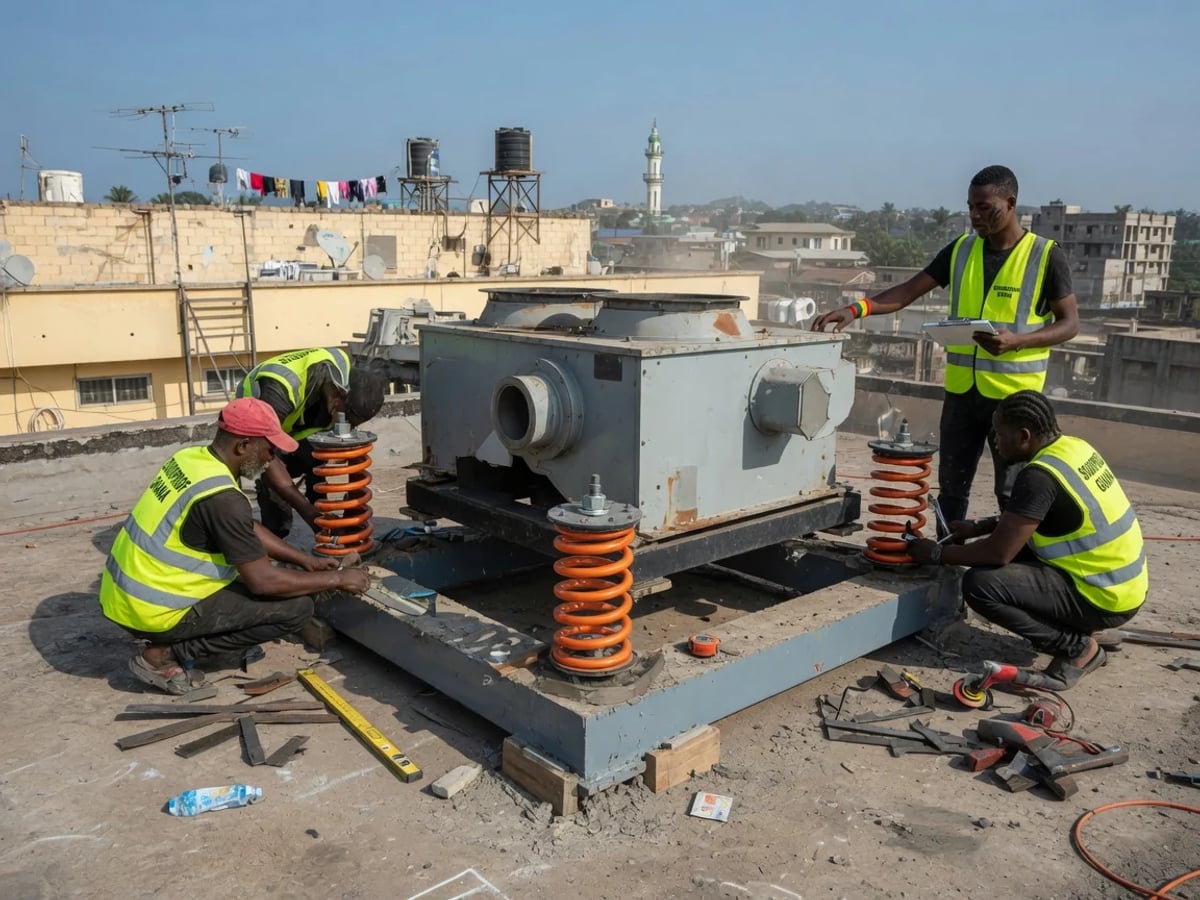
Structure-borne vibration isolated at source with anti-vibration mounts, spring hangers, and inertia bases — the path broken before it enters the building, designed to a measured target.
Our process
-
Assess
A free assessment traces the hum or rumble back to its source — a pump, generator, compressor, lift, or plant — and the structural path it travels through the building.
-
Measure
We assess where the vibration enters the structure and where it re-radiates, and set an isolation target for the affected rooms.
-
Design
We specify anti-vibration mounts, spring or neoprene isolators, spring hangers, or an inertia base — matched to the equipment's weight and running frequency.
-
Install
We isolate the equipment at its feet or mounting and fit flexible connectors so no rigid bridge lets vibration back into the structure.
-
Verify
We reassess the affected rooms and confirm the structure-borne hum has dropped to the agreed target.
The Challenge
Some of the most puzzling noise complaints have no obvious source in the room where they are heard. A low hum in a bedroom with no machine in it; a rumble in an office two floors above the plant room; a throb that seems to come from the walls themselves. This is structure-borne noise — vibration that enters the building fabric at one point and travels through concrete, steel, and blockwork to re-radiate as sound somewhere else entirely, often a surprising distance from where it began.
Structure-borne noise is different in kind from airborne noise, and this is why it defeats ordinary soundproofing. Airborne sound can be blocked by mass and sealing; but once vibration is inside the structure, adding mass or sealing gaps does little, because the sound is no longer travelling through the air — it is travelling through the building itself and radiating out of a solid surface. You cannot seal a slab against its own vibration. The only reliable fix is to stop the vibration entering the structure in the first place, by isolating the source that is feeding it.
Common sources in Ghana include generator sets, water pumps and pressure sets, AC compressors and chillers, lift machinery, and industrial plant — all of which shake as they run and, if bolted rigidly to a slab or wall, pump that vibration straight into the building. The equipment is often working perfectly; it is simply coupled to the structure in a way that turns the whole building into a sounding board.
The Soundproof Ghana Solution
We treat structure-borne noise at the only place it can be truly solved: the connection between the vibrating equipment and the building. First we trace the hum back to its source and identify exactly where the vibration is entering the structure — the machine feet, a pipe bracket, a duct hanger, or a rigid mounting. Then we break that path with the right isolation for the equipment’s weight and running frequency: anti-vibration mounts, spring or neoprene isolators, spring hangers for suspended plant and ductwork, or an inertia base for heavier machinery that needs a stable, isolated mass beneath it.
The engineering matters because isolation must be matched to the equipment. An isolator too stiff for the load passes the vibration straight through; one selected correctly lets the machine move on its mounts while the structure stays still — like cutting a taut string in the middle so the far end no longer moves. We also fit flexible connectors on the pipes, ducts, and conduits leaving the machine, because a single rigid pipe or bracket will “short-circuit” even the best mounts and carry the vibration back into the building. Every rigid bridge has to be found and broken.
We commit to a measured reduction of the structure-borne hum in the affected rooms to an agreed target, verified before and after — not a promise that a running machine will produce no vibration at all.
Service Framework
- Free assessment tracing the hum or rumble to its source and structural path
- Assessment of where vibration enters and re-radiates, with an isolation target for the affected rooms
- Anti-vibration mounts and spring or neoprene isolators matched to load and running frequency
- Spring hangers for suspended plant, pipework, and ductwork
- Inertia bases for heavier machinery needing an isolated, stable mass
- Flexible connectors on pipes, ducts, and conduits to remove rigid bridges
- Before-and-after verification of the structure-borne level in affected rooms
Typical Engagement
A vibration engagement usually centres on a specific piece of plant whose hum is being felt elsewhere in a building — a generator, pump, compressor, chiller, or lift in a home, apartment block, office, hotel, or industrial site in Accra, Tema, or Kumasi. The work is often localised to the equipment and its connections rather than the affected room, which means it can frequently be carried out without disrupting the people experiencing the noise. Where the source is a generator or HVAC plant, we coordinate the isolation with the wider enclosure or duct-silencing work so the whole noise picture is addressed together.
Outcomes
- Structure-borne hum and rumble reduced to a measured target in the rooms where it was felt
- The vibration stopped at source, the only place structure-borne noise can be reliably solved
- Isolation matched to each machine’s weight and frequency, so the mounts actually work
- Rigid bridges through pipes and ducts found and broken, so isolation is not short-circuited
- Equipment left running normally, with a documented before-and-after result
Book a free noise assessment: +233 20 531 3333.