Vibration Isolation
Structure-borne noise control — spring and neoprene isolation mounts, inertia bases, resilient hangers and float systems that stop plant, AV and generator vibration travelling through the building frame across Greater Accra.
Some noise you cannot chase with thicker walls, because it is not travelling through the air — it is travelling through the building. A generator on the roof, a chiller in the plant room or an AV subwoofer on the floor above can pump a low hum straight into the concrete frame, which carries it efficiently to rooms far from the source. Vibration isolation breaks that path at source. Soundproof Ghana designs and installs structure-borne noise control for plant, AV and generators across Greater Accra. Book a free noise assessment: +233 20 531 3333.
What Vibration Isolation Is
There are two families of building noise. Airborne noise — speech, music, traffic, a generator’s exhaust roar — travels through the air and vibrates a surface it meets. Structure-borne noise starts as physical vibration in a machine and travels through the solid structure of the building, re-radiating as sound in a distant room. A useful way to picture it: airborne noise is shouting at your wall; structure-borne noise is knocking on it — and the knock is felt three floors away.
Concrete is an excellent conductor of that energy, which is exactly why the low drone of a chiller, pump, lift motor or generator can appear in a room that shares no wall or window with the plant. You cannot absorb or block your way out of it in the affected room, because the sound is being generated by the room’s own structure set into motion. The only durable fix is to stop the vibration entering the structure in the first place — to isolate the machine from what it is bolted to.
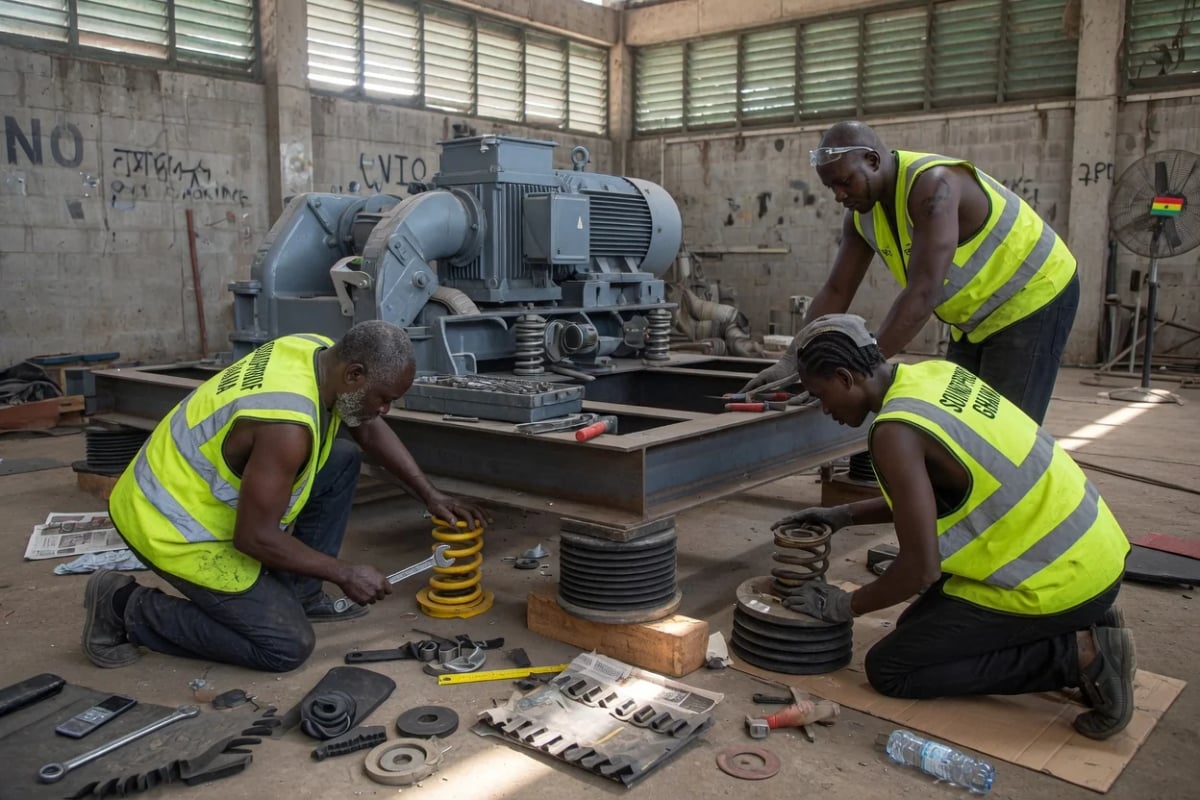
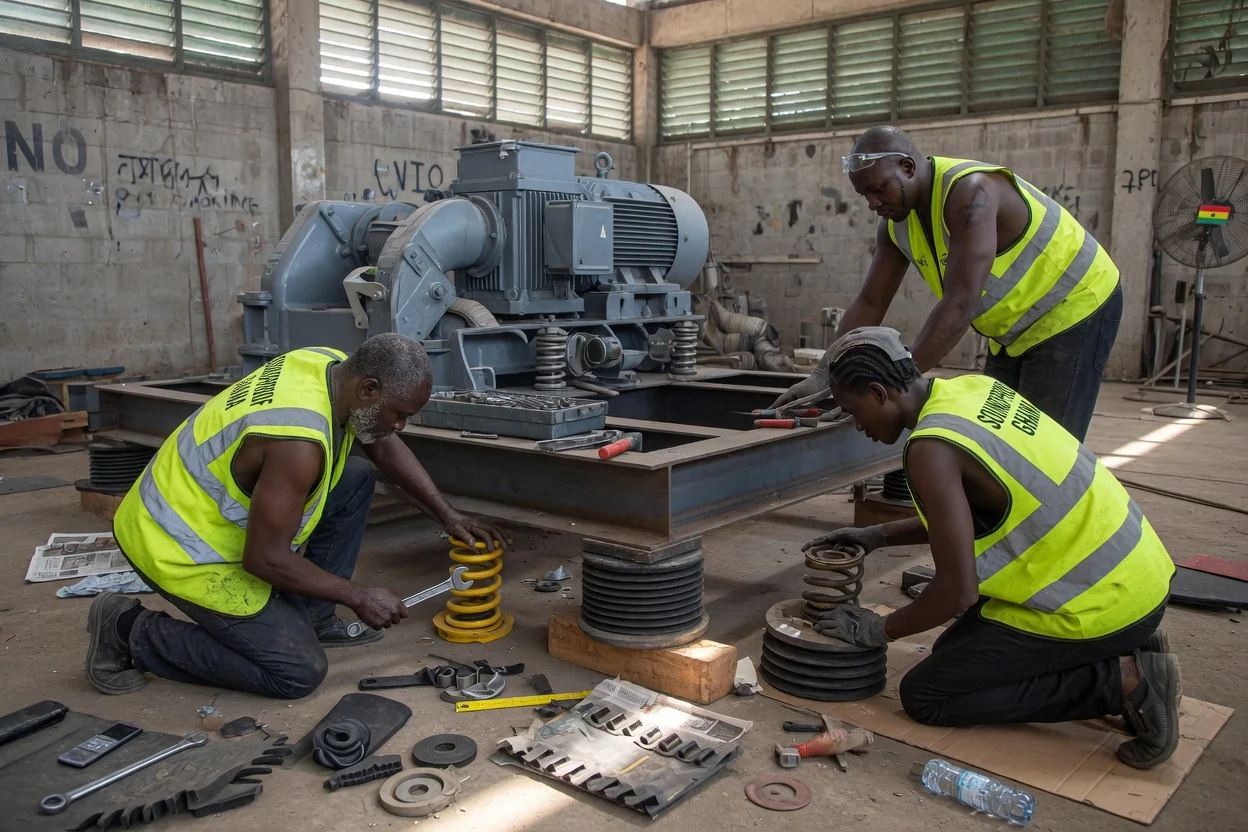
Vibration isolation does exactly that. By resting equipment on correctly chosen resilient elements — steel springs, neoprene mounts, or a combination — and by adding mass and stability with an inertia base where required, we create a soft, tuned interruption in the path. The machine still vibrates; the building no longer has to.
When to Specify Vibration Isolation
Specify it whenever a low hum, drone or thump reaches a space that has no direct airborne route to the source. The common Ghana cases are: rooftop or ground-level generators transmitting into the building below; plant-room equipment — chillers, air-handling units, pumps, cooling towers — humming through the frame into offices and apartments; transformers and switchgear producing a persistent mains-frequency drone; lift motor rooms knocking into adjacent bedrooms; and AV systems — cinema and club subwoofers, studio monitors — whose bass loads directly into the floor and travels to the storey below.
It is also specified proactively at design stage. The cheapest, most effective isolation is designed in before the plant is set — mounting details, inertia bases, resilient pipe and duct supports and flexible connectors specified alongside the mechanical layout. Retrofitting after complaints is possible and something we do often, but designing it in is always the better value.
Our Method — Which Pillars We Use
Vibration isolation is the decoupling pillar of acoustics applied to machinery, supported by mass where an inertia base is needed for stability. The engineering lives in the detail.
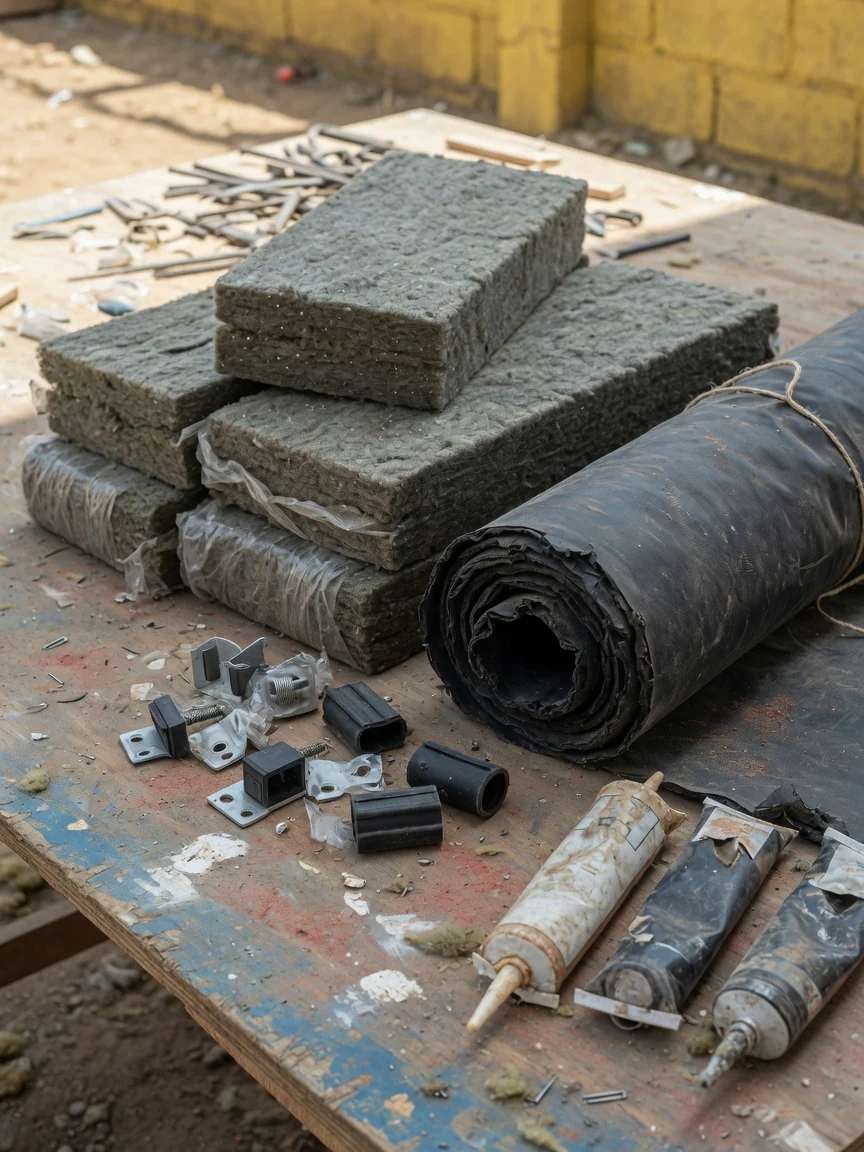
- Isolation mounts: steel spring isolators for low-frequency, heavy or slow-running plant; neoprene and rubber mounts for higher-frequency or lighter equipment. The mount’s natural frequency is chosen to sit well below the machine’s disturbing frequency — that ratio is what determines how much vibration is stopped.
- Inertia bases: a concrete-filled steel frame under the machine adds mass and a low centre of gravity, steadying the equipment so the springs work correctly and reducing motion — essential for pumps and reciprocating plant.
- Spring hangers and resilient supports: suspended pipework, ductwork and ceiling-mounted equipment are hung on spring or neoprene hangers so vibration does not pass into the slab above.
- Flexible connectors: flexible couplings on pipes, ducts and electrical conduit close the “short circuits” — the rigid connections that would otherwise carry vibration straight past the isolators and defeat the whole scheme.
Typical Result Ranges
Correctly selected isolation removes the great majority of transmitted vibration energy at the frequencies that matter — the low hums and drones that structure-borne problems produce. In practical terms, a persistent hum that was clearly audible in a bedroom or office typically drops to the point where it no longer intrudes, and we express that as a measured reduction in the affected room rather than a headline figure that ignores your specific frequencies. The exact result depends on the machine’s lowest disturbing frequency, its weight and the structure it sits on, which is why we measure before we specify. We set the target with you at survey stage and verify it with the plant running before handover.
The one honest caveat: the lower the frequency, the harder it is to stop, and very low bass may need springs of a particular deflection plus an inertia base to reach the target. We design for that lowest problem frequency from the start rather than discovering it at commissioning.
Honest Boundaries
Vibration isolation is precise engineering, not a universal cure. It does nothing for airborne sound — if you can hear a generator’s exhaust roar through a window, that is an enclosure and glazing problem, not an isolation one. An isolator of the wrong stiffness can actually amplify vibration near its resonance, so selection matters and guesswork is dangerous; this is why we measure the equipment’s running frequency rather than fitting a standard mount. We will not promise “zero vibration” — we commit to a measured reduction against a target agreed at survey, verified before and after. And isolation only works if every rigid contact is broken: a single unbroken pipe or conduit can short-circuit an otherwise perfect scheme, so the detailing is where the result is won or lost.
Related Services
Structure-borne noise rarely arrives alone. These pair naturally with vibration isolation:
- Generator Acoustic Enclosures — isolate the genset and enclose its airborne roar together
- HVAC Noise Control — duct silencers and plant isolation as one mechanical-noise package
- Commercial & Venue Acoustic Fit-Out — where isolated plant and rooms are designed in from the start